
2026-08-05
Humidity Sensors on Equestrian Arenas: The Data You Have and Aren't Using
Most equestrian facilities already have humidity sensors installed on their arenas, but the data they generate goes to waste — unread and unacted upon. Custom software turns those raw readings into automatic operational decisions.
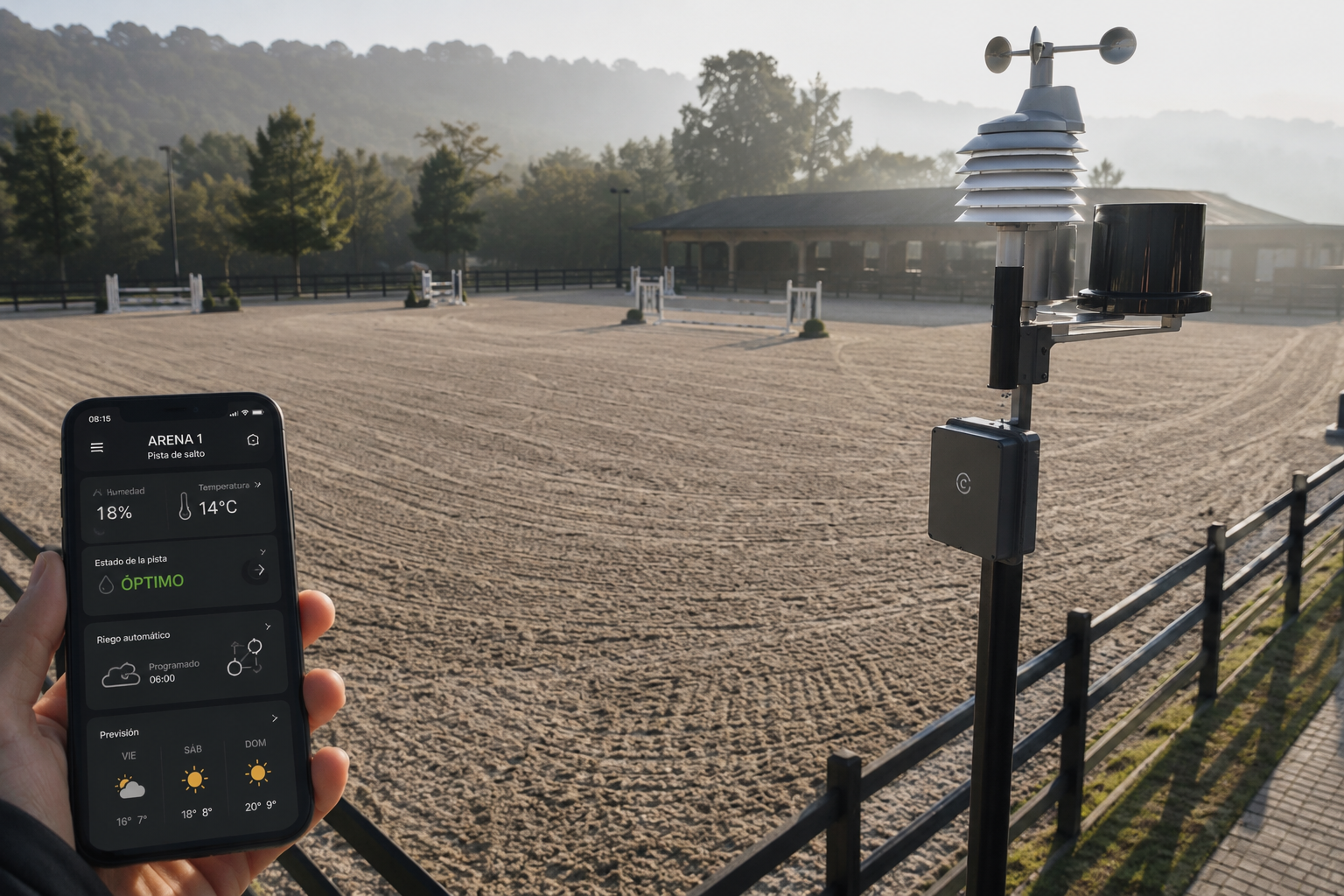
The data is there. The problem is what happens next.
If you manage an equestrian facility with any track record, chances are you've already invested in humidity sensors for your arenas. Maybe you installed them to control irrigation, to meet a technical recommendation, or simply because your arena supplier included them in the project. They're there, measuring, generating readings every few minutes.
And yet — how many times a day do you actually check that data systematically? How many real operational decisions — irrigate or not, open or close the arena, send an alert to the team — are actually made based on those readings? Or do you still rely on someone walking out, pressing a boot into the ground, and making a gut call on whether the surface is fit for use?
This is the problem nobody talks about — but it costs money, time, and injured horses every season.
Why it happens: you have infrastructure, but not intelligence
Humidity sensors are hardware. They do their job well: they measure. But measuring is not the same as interpreting, and interpreting is not the same as acting.
Most equestrian facilities find themselves in a situation we could call "orphaned data": the information exists, but has nowhere to go. Data is stored in a proprietary system from the sensor manufacturer, in a generic home automation app, or — at best — in a spreadsheet someone updates when they remember to. There's no connection to the arena booking system. There are no automatic rules that trigger an action when humidity drops below a critical threshold. There's no historical record to help anticipate when irrigation will be needed ahead of a competition.
The result: the information exists but isn't working for you. And that has very real consequences.
The cost of not connecting the dots
Poor arena conditions that no one caught in time. An arena that's too dry generates dust, increases the risk of joint injuries in horses, and degrades the surface material. An arena that's too wet is slippery and can ruin a training session — or worse, a competition. When detection depends on human supervision, the margin for error widens. Someone has to be in the right place, at the right time, with the right judgment.
Uncontrolled water and energy consumption. Without automation driven by real data, irrigation is scheduled on fixed timetables or subjective judgment. That means watering when it isn't needed, or failing to water when it is. Across a multi-arena facility, the cumulative waste over a season is significant — both in financial cost and environmental impact.
Operational responsibility concentrated in one person. When there's no system to interpret and act, someone has to do it manually. That someone is usually the maintenance manager, the head groom, or — in smaller facilities — the owner themselves. That dependency is fragile: holidays, sick leave, staff turnover. If that person isn't there, the system breaks down.
No traceability for events and competitions. When you host a competition, arena condition is a critical factor. If you don't have a historical record of surface conditions — with objective data, not handwritten notes — you can't demonstrate that the arena was in optimal shape, and you can't learn from it for the next event. The lack of traceability also complicates relationships with vets, judges, and external organizers.
Reactive decisions instead of preventive ones. Without centralized, interpreted data, you're always one step behind. You act when the problem is already visible — not before. And in the equestrian world, by the time the problem is visible, it's already cost you something: time, money, or a horse's wellbeing.
The solution: software that turns readings into decisions
What you need isn't more hardware. You already have the sensors. What you need is an intelligent software layer that centralizes that data, interprets it in context, and triggers automatic actions or alerts when appropriate.
This is exactly what Equestrian Partners designs and builds: custom systems that connect the sensor infrastructure you already have to the real operational processes of your facility.
What does it look like in practice?
-
Real-time data centralization. Every sensor across every arena sends its readings to a single platform, accessible from any device. No more separate apps, no more spreadsheets.
-
Automatic rules based on thresholds. You define the optimal parameters for each arena — which can vary by surface type, discipline, or time of year — and the system acts on its own: activating irrigation, stopping it, alerting the team, or automatically blocking arena bookings when conditions aren't suitable.
-
Historical data and analytics. Every reading is logged. You can track how conditions evolve across each arena over time, identify seasonal patterns, optimize irrigation cycles, and generate objective reports for events or audits.
-
Smart alerts. The system doesn't bombard you with irrelevant notifications. It only flags what genuinely requires your attention and can't be resolved automatically.
This kind of solution isn't science fiction, and it isn't reserved for large-scale facilities. It's accessible technology, built to fit your specific operation, your existing infrastructure, and your team.
The same pattern repeats across the equestrian industry
What we've described with humidity sensors isn't an isolated case. It's a symptom of a broader problem: the equestrian sector generates valuable operational data that isn't being used, because the software layer to connect it and make it actionable simply isn't there.
The same applies to horse transport fleet management, where route, temperature, and animal welfare data travel through disconnected systems. Or in equestrian auctions, where generic platforms aren't built for the specific dynamics of bidding in the horse world — as we explore in depth in Online bidding at equestrian auctions: why most generic platforms fall short and what a purpose-built solution needs.
In every one of these cases, the answer isn't buying more generic technology. It's building software that understands the equestrian business from the inside out.
What separates a facility that scales from one that just survives
Equestrian facilities that are growing sustainably share one thing in common: they've stopped relying on constant manual supervision for repeatable operational tasks. They've built systems that work even when no one is watching.
This isn't about removing human judgment from the equation. It's about reserving it for decisions that genuinely require it — and letting technology handle the rest with precision and consistency.
A data-driven arena management system doesn't just improve surface conditions. It reduces resource consumption, protects the animals, enhances the client experience, and frees up your team's time for higher-value work. And when the time comes to host an event or face an audit, you have the data to prove it.
Equestrian Partners: technology built for the equestrian business
At Equestrian Partners, we design and build custom software, automations, and system integrations for businesses in the equestrian sector. We don't adapt generic solutions — we build from the ground up exactly what your business needs, combining technical expertise with deep industry knowledge.
If you manage an equestrian facility and feel like your operational data isn't working for you, now is the time to change that. You don't need more sensors. You need the software that makes them intelligent.
Book a strategy session with our team and in 45 minutes we'll show you exactly what can be automated in your facility, what data you already have available, and how a custom system can turn it into real operational decisions.
Frequently asked questions
Is your operational data not working for you? Book a free strategy session with the Equestrian Partners team. In 45 minutes, we'll analyse your facility, identify what you can automate with what you already have, and show you how custom software can turn your sensor readings into real operational decisions.
Book your strategy session