
2026-08-05
Online bidding at equestrian auctions: why most generic platforms fall short and what a purpose-built solution requires
Generic auction platforms ignore the realities of the equestrian world, creating friction that costs sales, triggers legal disputes, and damages reputations. Purpose-built software designed for the sector solves what no off-the-shelf tool ever can.
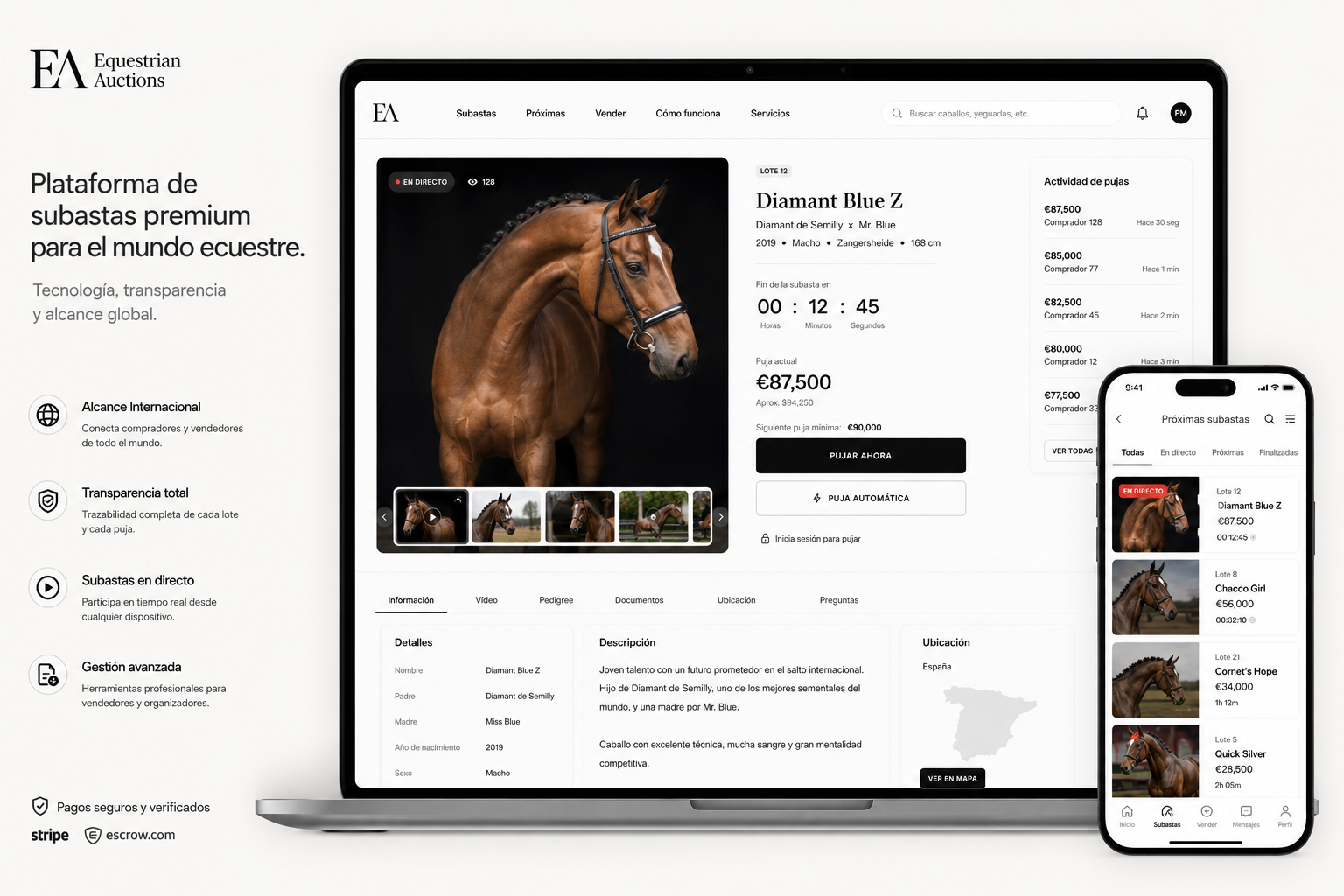
The problem nobody talks about out loud
You're organizing a high-value horse auction. You've spent months building the catalogue, coordinating veterinary inspections, negotiating with breeders, and generating excitement among buyers from multiple countries. The day of online bidding arrives — and the platform you're using, the same one that handles agricultural machinery and contemporary art, starts showing its limits.
A bidder wins the lot for a pregnant mare, but the platform has no way to automatically link the unborn foal as part of the same lot. Another buyer places a bid on a horse whose veterinary review is still pending, with no system block in place and no clear disclosure of the suspensive condition. The deposit you require varies by animal value, but the platform only supports a fixed percentage. And when the winning buyer asks for the studbook number of the horse they just acquired, you have to look it up manually in a separate system and send it by email.
This isn't a minor technical inconvenience. It's operational friction that erodes trust, generates disputes, and — in the worst cases — unravels deals that should have closed without a hitch.
Why it happens: generic platforms were never built for this
General-purpose online auction platforms — and there are many, some with strong reputations — are built on a universal logic: one lot, one starting price, one winner, one payment. That logic works perfectly for auctioning a watch, a painting, or a tractor. But equestrian auctions have a set of specific requirements that no generic platform addresses out of the box.
Linked lots. In the equestrian world, it's common to auction a mare alongside her foal at foot, or a horse together with breeding rights or frozen embryos. These linkages carry contractual, logistical, and registration implications that must be reflected in the platform from the outset. If the system can't handle them, the organizer has to manage them manually — with all the risk of error that entails.
Veterinary suspensive conditions. Many elite auctions allow bidding on a horse whose official veterinary review hasn't yet concluded, with the sale conditional on the outcome. This requires intermediate states within the bidding workflow — "conditionally awarded," "under review," "confirmed," or "voided" — that a standard platform simply doesn't have. The typical result is that organizers manage these states via email, with all the traceability issues and potential disputes that follow.
Variable deposits. The guarantee deposit a buyer must pay to participate in an equestrian auction is rarely a fixed percentage of the starting price. It depends on the animal's estimated value, the buyer's profile, whether it's their first transaction with the organizer, and whether the lot includes additional elements. Generic platforms don't support that conditional logic. They apply a fixed percentage — or nothing at all.
Integration with studbooks and official registries. A purebred horse isn't just an animal: it's a file. Studbook number, verified pedigree, performance test results, reproductive health certificates. All of that information should be available in real time to the bidder during the bidding process, and should update automatically in the relevant registries once the lot is awarded. No generic platform offers that integration — because it was never designed to. It was built for a different world entirely.
The consequences of ignoring the problem
The cost of using the wrong tool isn't always immediately visible — but it compounds.
First, there's the direct operational cost: hours of manual work to handle everything the platform doesn't automate. Coordinators sending emails with award statuses, assistants manually checking whether a veterinary report has come in, registry managers updating studbooks by hand after every auction. In a sale of 40 or 50 lots, that work can add up to days of effort that generate zero value.
Second, there's the reputational cost. An international buyer bidding in your online auction expects the same experience they'd have on any leading platform in their field. If the process is confusing, if lot statuses aren't clear, if they have to call to find out whether their deposit was processed correctly — they won't be back. And in the high-value equestrian market, losing a repeat buyer has an impact that extends far beyond a single transaction.
Third — and most seriously — there's the legal cost. Poorly managed suspensive conditions, incorrectly applied deposits, and linked lot awards that aren't properly documented are the source of disputes that can end in arbitration or litigation. The high-value equestrian sector operates with complex contracts and sophisticated buyers who know their rights.
And there's a fourth cost that rarely gets mentioned: opportunity cost. A well-run auction with a smooth, professional bidding experience attracts more bidders, drives more competition between them, and pushes final prices higher. An auction full of friction does exactly the opposite.
What an equestrian auction platform actually needs
This isn't about bolting extra features onto a generic platform. It's about building a solution that understands the business from the ground up.
A purpose-built equestrian auction platform must include, at a minimum, the following:
- Composite and linked lot management, with joint or separate award rules defined by the organizer.
- Conditional status workflows for lots subject to veterinary review, with automatic notifications to buyers and sellers at every status change.
- Variable deposit engine, capable of calculating and managing guarantees based on multiple criteria: lot value, buyer history, auction type.
- Integration with studbooks and official registries, so that pedigree and health information is available in real time during bidding and updates automatically upon award.
- Organizer dashboard with full visibility into the status of every lot, every bidder, and every transaction — no external systems required.
- Professional bidding experience for international buyers, with multilingual support, per-lot downloadable documentation, and automated communications at every stage of the process.
None of this is science fiction. It's software engineering applied to a specific business. And it's precisely what a generic platform cannot deliver — no matter how much you customize it.
One more thing: if your auction involves horses that need to be transported after the award — which is virtually always the case — logistics coordination is another critical point. A well-designed platform can integrate with the transport and documentation processes involved. If you want a clearer picture of that side of the operation, the Complete guide to transporting horses safely: pre-departure checklist is a useful resource for understanding what needs to be in place before the horse leaves the premises.
Why custom software is the only real answer
The usual temptation is to find an online auction platform that "looks close enough" to what you need and adapt it. The problem is that adaptation always hits a ceiling. You can customize the look, add text fields, change the wording in automated emails. But you can't change the underlying business logic if you don't have access to the code.
Software built specifically for your equestrian auction operation is a strategic asset. It's not a technology expense — it's the infrastructure that makes it possible to scale, professionalize, and protect your business. Every workflow, every rule, every integration is built for your specific requirements, not for a generic marketplace.
Equestrian Partners designs and builds that solution
At Equestrian Partners, we develop bespoke software, artificial intelligence, automations, and system integrations exclusively for businesses in the equestrian sector. We know the realities of auction operations: linked lots, suspensive conditions, studbooks, variable deposits. We don't need to learn them from scratch — this is the industry we work in.
If you run equestrian auctions and you're managing them with tools that were never designed for your business, the time to change that is before your next event — not after.
Book a strategy session with our team. In one hour, we'll analyse your current operation, identify the friction points, and show you what a solution built specifically for you would look like.
Frequently asked questions
If you run equestrian auctions and you're using tools that were never designed for your business, every event you run without fixing that has a real cost. Book a strategy session with the Equestrian Partners team: we'll analyse your operation, identify the friction points, and show you what a platform built exclusively for you would look like.
Book your strategy session